

2022-08-15 14:49:59 Views:1756
What is Interventional Therapy? Interventional therapy is the use of puncture needles, catheters and other interventional equipment under the guidance and monitoring of imaging equipment such as digital subtraction angiography, CT, ultrasound, and magnetic resonance to introduce specific instruments into the human body through natural human orifices or tiny wounds. The general term for a series of techniques for minimally invasive treatment of lesions.
Interventional therapy has no or small incision. In most cases, only a few millimeters of skin incision can be used to complete the treatment. Compared with other surgeries, interventional therapy can also have a very good therapeutic effect on elderly and critically ill patients who cannot tolerate surgery. In recent years, interventional radiology has achieved rapid development in many clinical fields with its significant advantages of minimally invasive, rapid, safe and effective, especially in the fields of cardiovascular, cerebrovascular, peripheral vascular and oncology. The three pillars of clinical practice are paralleled by surgery and surgery.
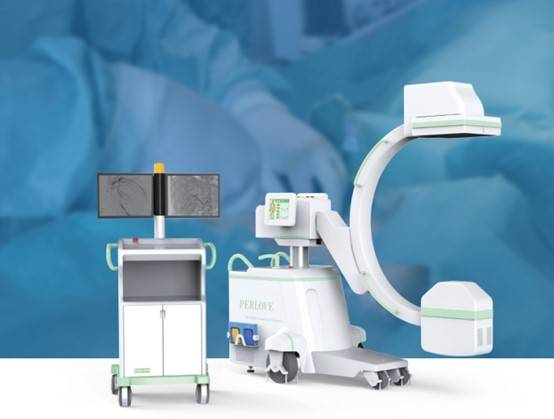
PLX7100A Mobile Panel Intervention C-arm
The mobile flat-panel interventional C-arm is an imaging device that can diagnose or treat local lesions under the guidance of interventional surgery. The mobile flat-panel interventional C-arm basically covers most of the current interventional surgeries, expanding the application of multiple departments in the hospital, thoracic surgery, gynecology, orthopedics, vascular surgery, urology... The main uses include orthopedic percutaneous vertebroplasty Surgery, lumbar internal fixation, urology ERCP, vascular surgery aortography, gynecological hysterosalpingography, etc.
For example, Perlove Medical's PLX7100A mobile flat-panel interventional C-arm can be used for ERCP in hepatobiliary surgery, hepatic hemangioma, internal and external drainage of biliary obstruction, etc. It is suitable for applications in various clinical departments and operating rooms. This mobile flat-panel interventional C-arm adopts 30cm×30cm amorphous silicon cesium iodide dynamic flat panel detector, the large flat panel can fully cover the surgical site; the intelligent image processing technology can greatly improve the image detail performance; the variable SID technology can reduce the distance between the flat panel and the patient and reduce the radiation dose It can also improve the image quality; the electric control of the C-arm movement, accurate positioning, fast direct access, fully improve the surgical efficiency and a comprehensive clinical scope of application.
In addition, the PLX7100A mobile flat-panel interventional C-arm can be linked with a high-pressure syringe pump, and a high-pressure syringe linkage interface is reserved, which can effectively realize the linkage between the high-pressure syringe and the C-arm exposure, and help doctors obtain high-quality and qualified angiography images in a short time. Compared with DSA, the mobile flat-panel interventional C-arm is more economical and practical, and has low requirements for space and space. It can be moved between departments, which is very suitable for promotion in primary hospitals.
From Dakar to Kédougou: Perlove Medical Closes the Medical Imaging Gap in Senegal
Read More »Perlove Medical Showcases Intelligent Medical Imaging Solutions at 2026 Philippine International Medical Exhibition
Read More » Perlove Medical to Showcase Advanced Medical Imaging Solutions at PhilMedical Expo 2026
Read More »🌍 WHX Miami 2026 – Exhibition Wrap-Up
Read More »Perlove Medical to Exhibit at WHX Miami — See You in Miami!
Read More »A Decade of Dedication, Echoing in the Market Again | Perlove Medical’s C-arms Deployed in Three Major Regional Hospitals in Bangladesh
Read More »