

2025-06-25 09:36:42 Views:1976
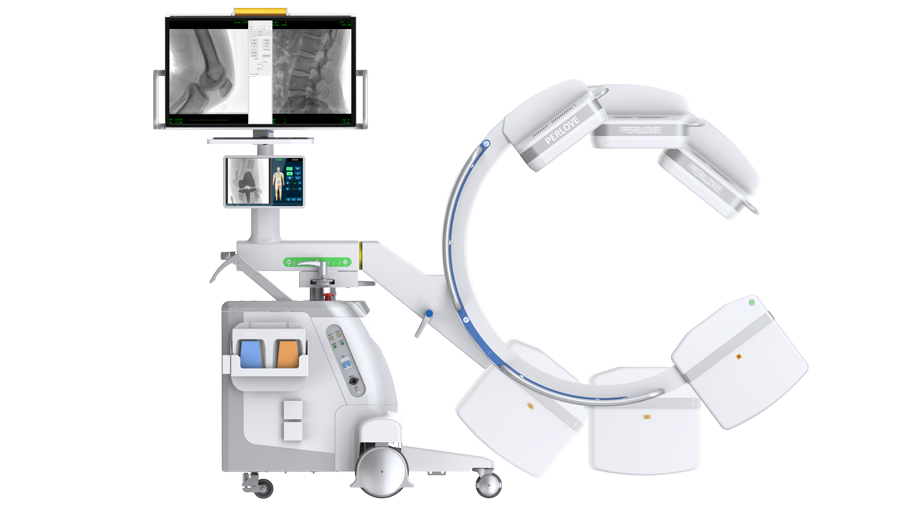
The C-arm is a distinctive type of medical X-ray imaging system, named for its characteristic C-shaped frame. Similar designs include the O-arm and G-arm systems. But what makes the C-arm configuration particularly suitable for clinical applications?
Optimized for Surgical Environments
The curved structure of the C-shaped frame allows the equipment to move freely and adjust angles within the operating room. This flexibility enables imaging from various positions without interfering with the surgical table or other equipment. For instance, mobile C-arms can maneuver around both sides of the surgical table to capture images from multiple angles.
Open Frame Advantage
The open distance between the X-ray tube and the detector (typically 700–800 mm) ensures ease of access around the operating table while minimizing physical contact with the patient or monitoring devices.
Reduced Scatter Radiation
The C-arm structure creates a near-closed-loop path between the X-ray source and the detector, shortening the travel distance of radiation. This helps to reduce scatter exposure for both patients and medical staff.
Isocentric Scanning
High-end C-arms, such as the PLX C7500A series by Perlove Medical, feature isocentric scanning technology. This ensures the patient remains at the center of the X-ray beam during imaging, reducing the need for repositioning and thus minimizing unnecessary radiation exposure.
Multi-Angle Imaging
C-arms can rotate more than 180°, enabling simultaneous anteroposterior and lateral imaging or even 3D scans. For example, the PLX C7600 3D C-arm by Perlove Medical achieves rapid 3D reconstruction through 190° rotation, supporting accurate anatomical localization.
Expanded Field of View
By repositioning the detector close to the table surface, the imaging area can be extended to cover large anatomical regions such as the chest, abdomen, and pelvis—reducing the need for repeated exposures.
Real-Time Dynamic Imaging
The C-arm design allows quick repositioning of the X-ray tube and detector, enabling surgeons to adjust views in real time without disrupting the surgical workflow.
Modular Functional Expansion
C-arms can be equipped with advanced features such as DSA (Digital Subtraction Angiography), 3D reconstruction, and surgical navigation to support complex interventional procedures. For example, Perlove’s PLA7100A model integrates DSA capabilities, supporting over 80% of vascular intervention procedures.
Robotic Surgery Compatibility
The flexibility of the C-arm design also allows seamless integration with orthopedic surgical robots. Real-time imaging guides the robotic arms with high precision. Perlove’s 3D C-arm models are capable of robotic synchronization, achieving sub-millimeter accuracy in navigation and positioning.
From Dakar to Kédougou: Perlove Medical Closes the Medical Imaging Gap in Senegal
Read More »Perlove Medical Showcases Intelligent Medical Imaging Solutions at 2026 Philippine International Medical Exhibition
Read More » Perlove Medical to Showcase Advanced Medical Imaging Solutions at PhilMedical Expo 2026
Read More »🌍 WHX Miami 2026 – Exhibition Wrap-Up
Read More »Perlove Medical to Exhibit at WHX Miami — See You in Miami!
Read More »A Decade of Dedication, Echoing in the Market Again | Perlove Medical’s C-arms Deployed in Three Major Regional Hospitals in Bangladesh
Read More »