

2025-12-17 16:32:12 Views:1619
With the assistance of the Perlove orthopedic surgical robot, the orthopedic team at Children's Hospital of Nanjing Medical University has successfully completed multiple pediatric scoliosis correction surgeries.
Children’s bones are small in volume, with narrow pedicle channels accompanied by vertebral deformities. To avoid irreversible spinal cord injury caused by repeated punctures, surgeons had to place each pedicle screw correctly on the first attempt, with no room for adjustments. The percutaneous approach presented extreme technical difficulty, making screw insertion comparable to navigating blindly.".
Children’s bone density is only 20% of that of adults.After resection of the pathological vertebrae in scoliosis correction surgery, short-segment fixation is required, placing high demands on biomechanical stability. Due to the relatively soft bone quality in children, traditional screw placement techniques have a high risk of loosening, which can easily lead to internal fixation failure.
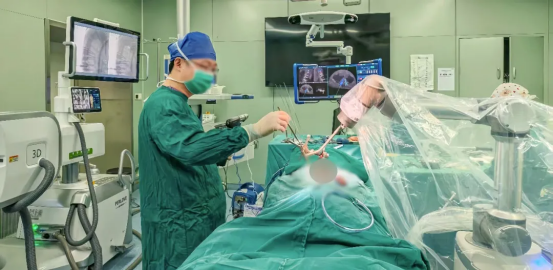
Children's Hospital of Nanjing Medical University has completed multiple highly complex pediatric scoliosis correction surgeries using a 3D C-arm system and an orthopedic surgical robot from Perlove Medical.
Patient: Female, 5 years old
Clinical Symptoms: Asymmetrical back, uneven shoulders, scoliosis
Surgical Indication: Congenital hemivertebra deformity accompanied by scoliosis, which affects normal growth and development. Surgical correction was necessary. Early surgical intervention can effectively prevent deformity progression and improve prognosis.
Surgical Approach: Posterior hemivertebrectomy combined with short-segment fixation and fusion
Surgical Goals: Eliminate the deforming element, correct spinal deformity, restore spinal balance, and preserve the patient's growth potential.
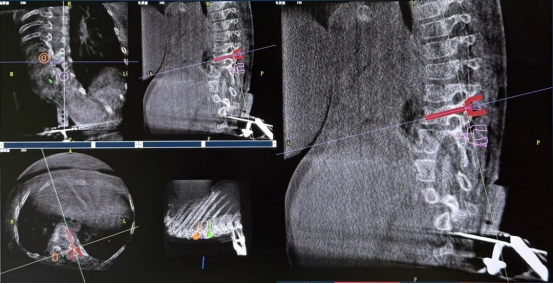
One-time planning for quadruple K-wire insertion
The robotic arm enhanced stabilization of surgical instruments, enabling precise execution. Guided by pre-planned trajectories, the system achieved accurate single-attempt pedicle screw placement within narrow vertebral pedicles - effectively navigating the 'anatomical labyrinth'. This approach eliminated risks associated with repeated positioning attempts. The fully integrated system demonstrated perfect coordination, successfully completing the implantation of four pedicle screws with sub-millimeter accuracy.
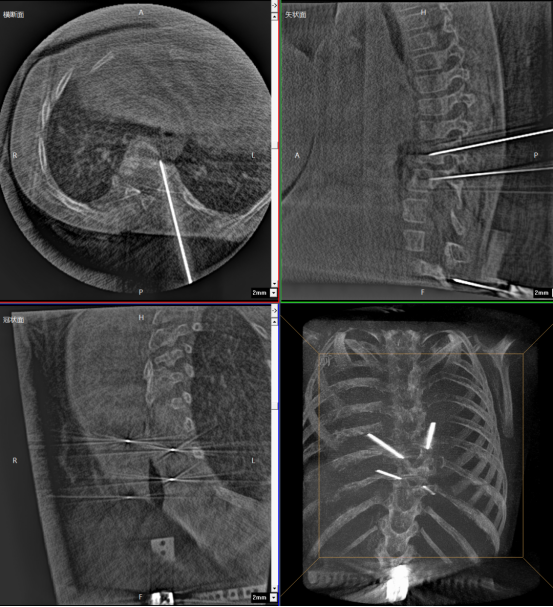
Fluoro-verified precise K-wire insertion
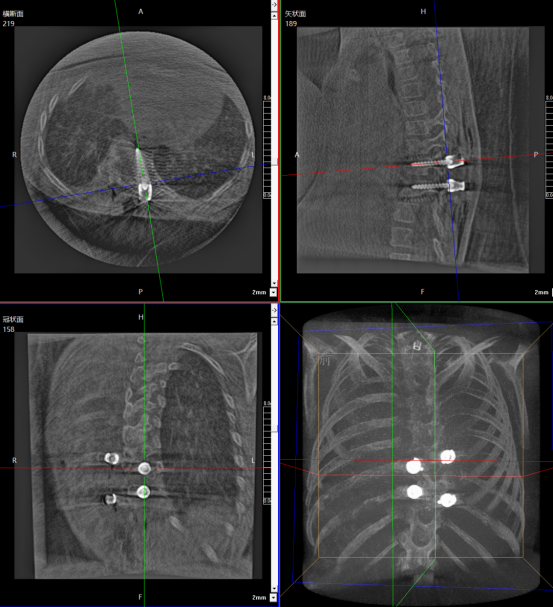
Fluoro-verified precise screw implantation
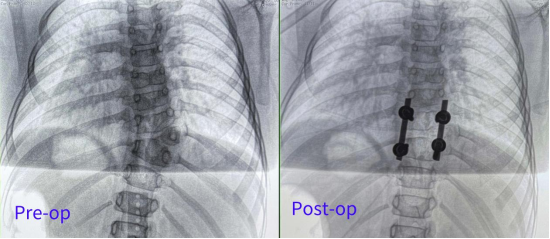
Age: 10 years
Gender: Female
Procedure: Spinal revision surgery
The patient initially underwent fixation with growing rods. However, due to rapid growth, the original fixation system could no longer accommodate her growth. A revision surgery was therefore required to adjust the fixation device and re-correct the spinal deformity.
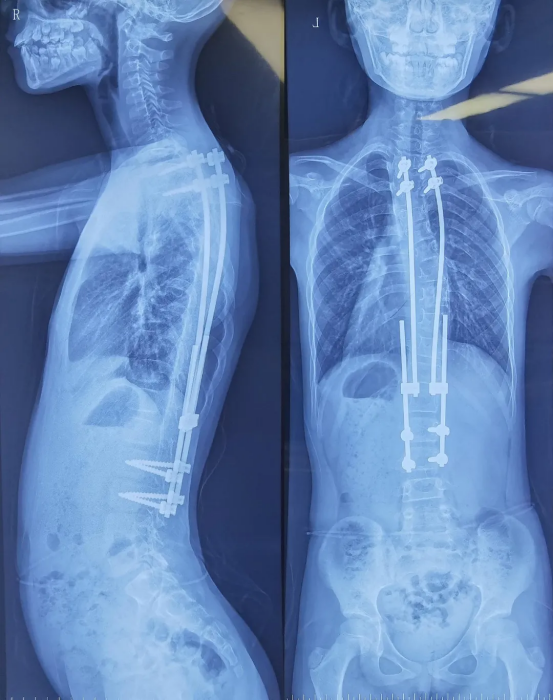
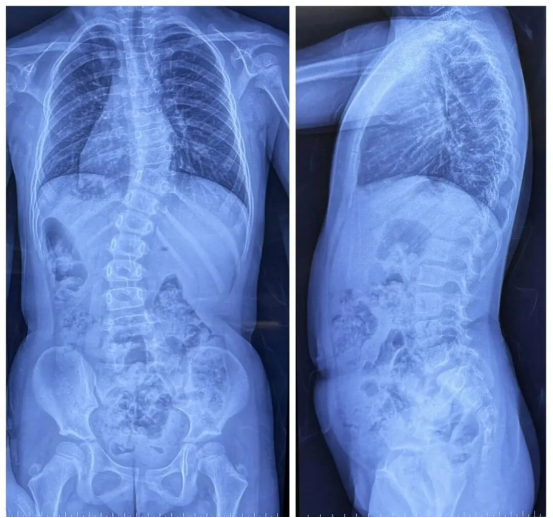
Preoperative imaging of the pediatric patient
Pediatric spinal revision surgery is far more complex than primary surgery. The core challenges lie in anatomical adhesions and limited surgical visibility. The initial operation oftentends to induce scar tissue formation around the spinal column, which adheres muscles, blood vessels, and nerves to adhere to the spine and internal fixation devices, significantly increasing surgical difficulty. At the same time, scar-induced visual obstruction blurs the surgical field and impairs the surgeon’s ability to accurately identify spinal segments.
Children’s bones are softer than those of adults, and the initial surgery may have already caused some degree of bone damage. During revision procedures, this further increases the difficulty of implanting internal fixation devices. Improper screw depth or angulation can easily lead to implant loosening and compromise surgical outcomes
The combination of three-dimensional imaging and a surgical robot effectively addresses the critical challenges of complex anatomy and the need for high-precision localization. This synergy enables visualized preoperative planning, sub-millimeter intraoperative positioning accuracy, and a significant reduction in surgical risks.
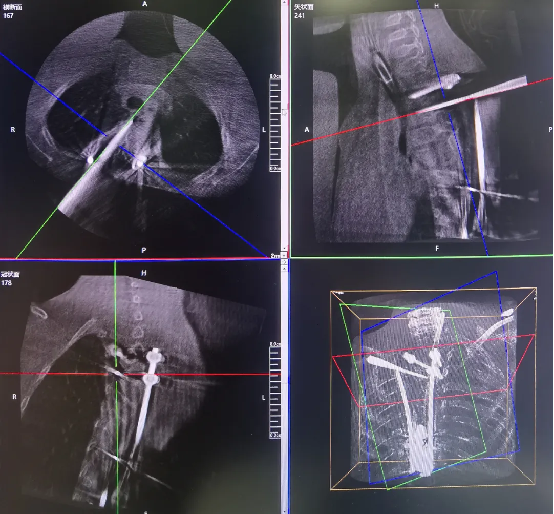
The 3D C-arm performs image acquisition and 3D reconstruction.
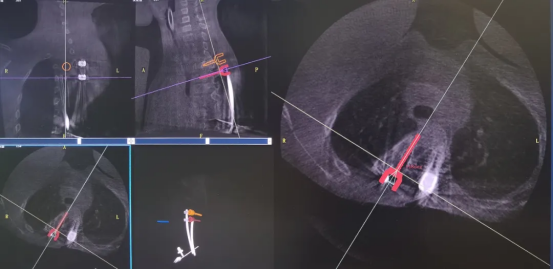
Robot-assisted screw insertion path planning
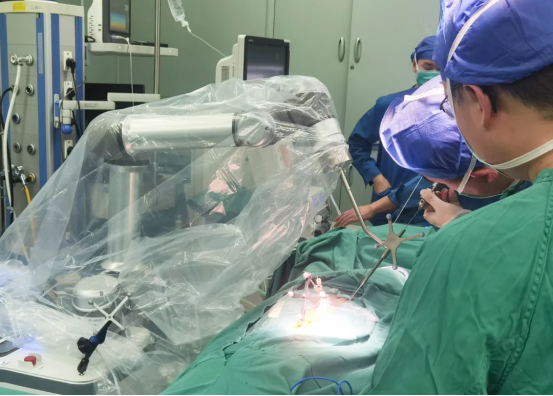
Robot-assisted precise precise screw placement.
The orthopedic team of Children's Hospital of Nanjing Medical University combines exquisite medical expertise with cutting-edge technology to safeguard the success of highly complex pediatric scoliosis correction surgeries, empowering children to straighten their spines and stride confidently toward a brilliant future.
A Decade of Dedication, Echoing in the Market Again | Perlove Medical’s C-arms Deployed in Three Major Regional Hospitals in Bangladesh
Read More »2026 Innovate Together, Grow Further丨Perlove Medical International Distributor Promotion Conference
Read More »PERLOVE MEDICAL at ECR 2026 | Advancing Radiology Innovation in Vienna
Read More »Perlove Medical at ECR 2026: Showcasing Cutting-Edge Imaging Solutions in Vienna
Read More »🌍 Elevating Global Healthcare | WHX Dubai 2026 Successfully Concluded
Read More »Join Us at ARAB HEALTH 2026 | See You in Dubai
Read More »